

Key Takeaways
True cost of car ownership
The true cost of owning a car includes every dollar you spend on a vehicle beyond what you paid at the dealership. This covers depreciation, loan interest, fuel, insurance, routine maintenance, tires, registration fees, and repairs. When these expenses are added together over a year, the total is often two to three times higher than the monthly payment alone. Understanding this full picture helps families budget accurately and avoid financial surprises.
Automotive analysts typically express total ownership cost on a per-mile or per-year basis, factoring in both fixed costs (insurance, registration, depreciation) and variable costs (fuel, maintenance, repairs) to allow consistent comparison across vehicle types.
Why the sticker price is a misleading starting point
Most families focus on the monthly payment when shopping for a car. That number feels concrete and manageable, but it covers only a portion of what a vehicle actually costs to own. The purchase price, whether paid in cash or financed, is just one line in a much longer budget.
A realistic picture of car ownership requires accounting for depreciation, financing interest, insurance premiums, fuel, routine maintenance, tires, registration, and repairs. Each of these costs is real and recurring. Families that plan around the payment alone often find themselves stretched thin once the other expenses arrive.
For context, AAA has estimated that the average American spends well over $10,000 per year to own and operate a new midsize sedan. That figure works out to more than $800 per month, which is frequently double or more than the loan payment itself.
$10,000+
Average annual new car ownership cost
AAA estimates the average American spends more than $10,000 per year to own and operate a new midsize sedan, including depreciation, fuel, insurance, and maintenance.
15-25%
First-year depreciation on a new vehicle
Most new vehicles lose between 15 and 25 percent of their purchase value within the first 12 months, making depreciation the single largest annual cost for many owners.
$1,900
Estimated annual fuel cost at 15,000 miles
Based on 15,000 miles driven, 28 MPG fuel economy, and a gas price of $3.50 per gallon, a typical driver spends close to $1,900 on fuel each year, before price changes.
50%
Value lost by year five for many new vehicles
Many new vehicles are worth approximately half their original purchase price after five years, which directly affects how much owners recover when selling or trading in.
Depreciation: the cost you never see on a bill
Depreciation is the reduction in your vehicle's market value over time. It does not appear as a monthly charge, but it is the largest single ownership cost for most new vehicle buyers. A new car can lose 15 to 25 percent of its value within the first 12 months. Over five years, many vehicles are worth 40 to 50 percent of their original price.
This matters because depreciation determines how much money you recover when you sell or trade in the vehicle. Buying a car that loses value quickly means you are effectively paying more per year for the privilege of driving it, even if the loan payment looks affordable.
Used vehicles depreciate more slowly because the steepest drop has already occurred. That is one reason a two- or three-year-old vehicle can offer lower total ownership cost than an equivalent new model, even if the used vehicle needs more maintenance. For a deeper look at how financing interacts with depreciation, see our article on decoding every line of a car loan.
Insurance, fuel, and maintenance: the recurring trio
After depreciation, three recurring costs shape annual ownership expense most directly.
Insurance is non-negotiable for legal vehicle operation in nearly every state. Premiums depend on your location, driving history, vehicle type, and coverage level. A full-coverage policy on a new vehicle can run $1,500 to $2,500 or more per year for many drivers. Urban areas and states with high litigation rates tend to carry higher premiums.
Fuel costs depend on how much you drive and your vehicle's efficiency. A driver covering 15,000 miles per year in a vehicle averaging 28 miles per gallon will purchase roughly 535 gallons annually. At $3.50 per gallon, that is close to $1,900 per year, before any price fluctuation.
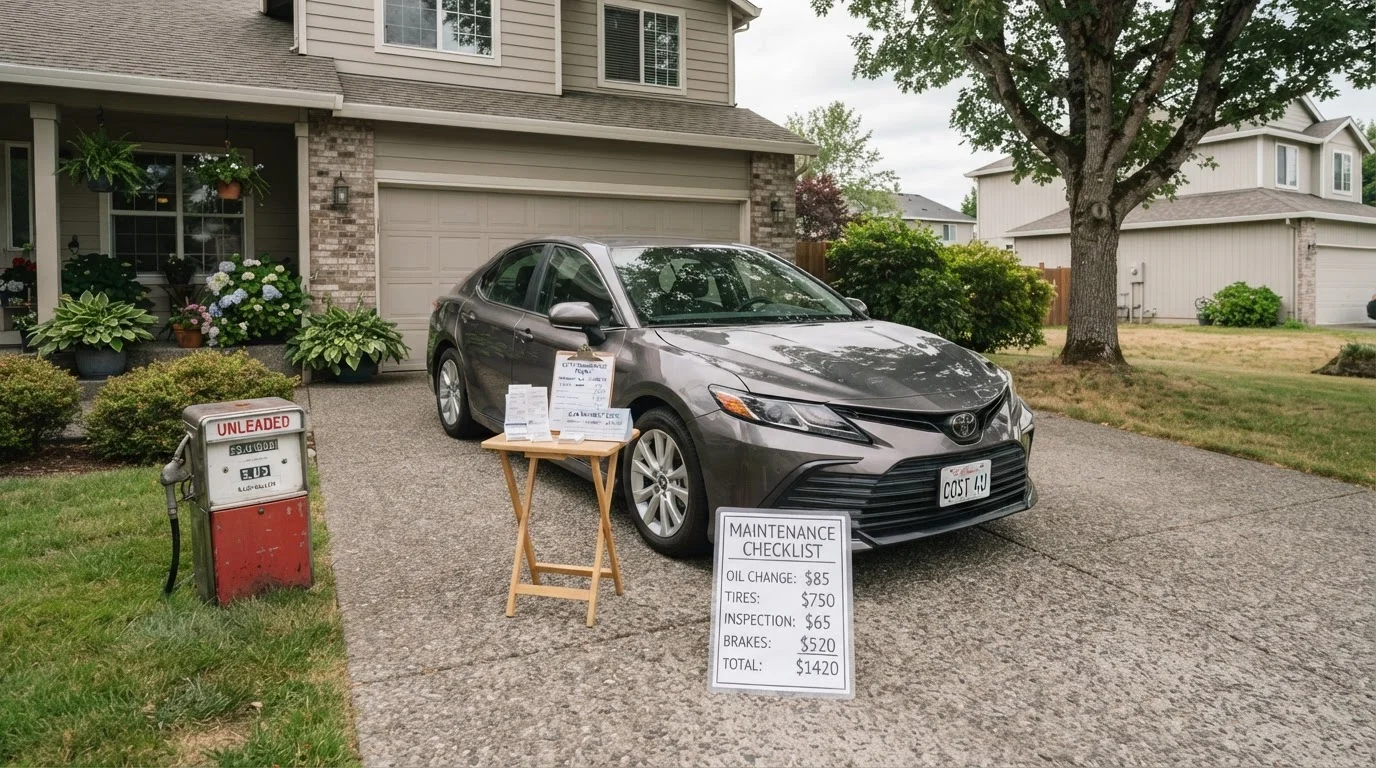
Maintenance is the cost category most often underestimated. Oil changes, tire rotations, brake service, air filters, and fluid replacements are regular expenses even on a reliable vehicle. Budgeting $500 to $1,000 per year for a well-maintained car is reasonable; older vehicles or those with deferred service may cost more. Consistent upkeep also prevents the kind of failures that generate repair bills in the thousands. The maintenance tasks that prevent costlier repairs are worth reviewing for any vehicle owner.
Fees, taxes, and the geography of car costs
Registration fees, title fees, and in some states annual vehicle property taxes add to the cost of ownership in ways that vary considerably by location. Some states charge a flat registration fee of $50 or less; others base the fee on the vehicle's value and can charge several hundred dollars per year for a newer model.
Gas taxes, which are built into the pump price, also differ by state and affect fuel costs for drivers who commute or travel frequently. States with tolled roads add another layer of recurring expense that urban and suburban drivers often absorb without calculating into their annual vehicle budget.
Insurance rates follow geography as well. A driver in a dense urban ZIP code typically pays more than someone in a rural area with the same vehicle and driving record, because accident frequency and repair costs differ by region. Our state-by-state annual car ownership cost overview breaks down how these figures compare across the US.
Families managing household budgets across multiple goals will find it useful to think of vehicle costs within a broader financial framework. The Family Finance hub covers strategies for keeping transportation costs in proportion to overall household spending.
Building a complete car budget
Putting a realistic car budget together means listing every category, not just the payment. A practical approach:
- Annual loan or lease payments (monthly payment times 12)
- Insurance premiums (get a quote before buying, not after)
- Estimated fuel cost based on your actual mileage and local prices
- Maintenance reserve of at least $500 to $1,000 per year
- Registration and any applicable property taxes
- A repair buffer for unexpected work, particularly on vehicles past their warranty
When you add those figures together, you have a truer picture of affordability than the monthly payment provides. If the total strains your household budget, a less expensive vehicle or a used model with lower depreciation may fit your finances better without sacrificing reliable transportation.
Several widely held assumptions about which costs matter most do not hold up under scrutiny. The article on automotive expense myths that cost drivers real money is a useful companion for families who want to separate common beliefs from actual costs.
This article provides general financial information for educational purposes and is not personalized financial or purchasing advice. Consult a qualified financial professional for guidance specific to your situation.