

Key Takeaways
Our Verdict
Envelope budgeting gives tactile, category-level control that works well for families prone to overspending on groceries, dining, or entertainment. Zero-based budgeting gives a complete picture of every dollar and adapts more naturally to variable income or complex household finances. Both methods outperform having no system at all.
| Best for | Recommended |
|---|---|
| Families who overspend in a handful of specific categories | Envelope budgeting |
| Households with variable income or many expense categories | Zero-based budgeting |
| Those new to budgeting who want a simple, visual method | Envelope budgeting |
| Those working within strict time or cost constraints who want total control | Zero-based budgeting |
How each method works
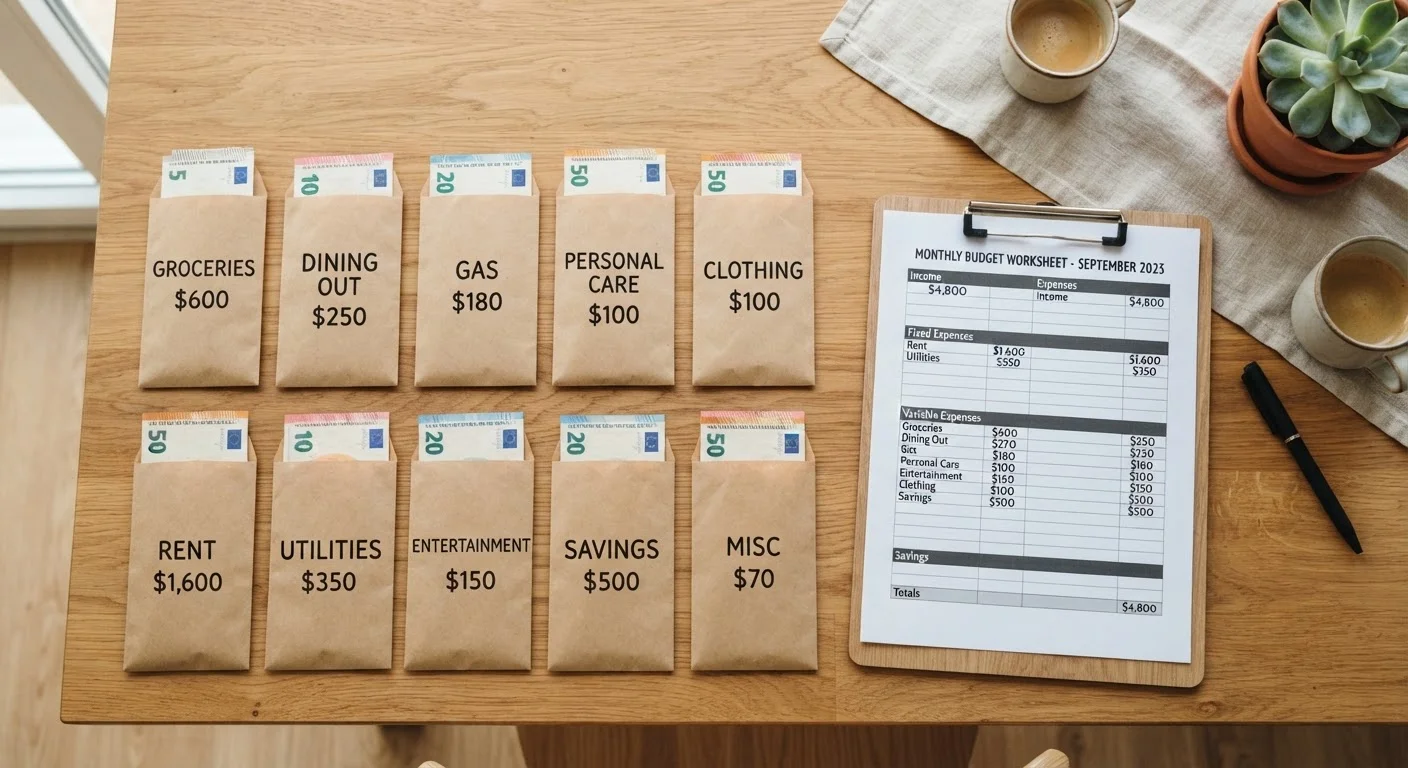
Envelope budgeting divides your monthly take-home pay into spending categories, each represented by an envelope. Groceries get $600, gas gets $150, dining out gets $200, and so on. When the cash in an envelope runs out, spending in that category stops for the month. Digital versions, including apps and spreadsheet tabs, replicate the same logic without physical bills.
Zero-based budgeting starts from a different angle. You list every dollar of expected monthly income, then assign each dollar to a category, a bill, a savings goal, or a debt payment, until the difference between income and assigned dollars is zero. Nothing is left unaccounted for. This does not mean you spend everything; it means every dollar has a named purpose, including the ones you set aside.
Both methods are forms of cash-flow budgeting. The core idea in each is that money should be directed deliberately, not just tracked after the fact. For a broader introduction to setting up a household budget, see Building a Family Budget From Scratch.
Practical differences side by side
The two methods diverge most clearly in setup time, flexibility, and how they handle irregular income.
| Envelope budgeting | Zero-based budgeting | |
|---|---|---|
| Setup time | Low to moderate | Moderate to high |
| Works with variable income | Harder to adapt | Designed for it |
| Covers savings and debt goals | Only if you build envelopes for them | Built in by design |
| Best psychological tool | Hard spending caps per category | Full dollar accountability |
| Monthly maintenance effort | Low once set up | Requires monthly rebuild |
| Risk of falling off track | Irregular expenses can derail it | Paper compliance without real tracking |
Envelope budgeting is easier to start. You pick your categories, allocate cash, and stop when each envelope empties. The ceiling on any category is visible and physical. The weakness is that it does not naturally account for every dollar, so savings goals and debt payments can get ignored if you do not build separate envelopes for them.
Zero-based budgeting takes more time to set up each month, especially if your income varies. You must know or estimate your income before you can assign dollars. However, because every category, including savings and debt, is in the plan from the start, nothing gets accidentally overlooked. Families carrying debt or building an emergency fund often find this structure useful. For context on how those two goals interact, see Emergency Fund vs. Paying Down Debt.
Where each method tends to break down
Envelope budgeting runs into trouble when a large, irregular expense (a car repair, a medical bill, a school fee) has no envelope. Families who do not build a miscellaneous or sinking-fund envelope often raid other envelopes or abandon the system after one surprise expense. The method also requires discipline when using digital versions, since the psychological friction of handing over cash disappears.
Zero-based budgeting is more prone to "paper compliance": the budget balances on a spreadsheet, but real spending does not match what was planned. This happens most often when categories are set too low, or when mid-month adjustments are made without updating the overall plan. It also demands more attention from households that deal with irregular or seasonal income.
Both methods share a common failure point: they require consistent tracking. Spending that goes unlogged or uncategorized for two weeks can unravel either system. Where Family Budgets Break Down covers the most common patterns that cause household budgets to fall apart.
Build a sinking fund envelope first
Before committing to either method, create a dedicated category for irregular expenses: car maintenance, annual insurance premiums, school supplies, and medical co-pays. Fund it with a small, fixed amount each month. Households that skip this step often cite one unexpected bill as the reason they quit their budget system.
Choosing based on your household's situation
Households with steady, predictable paychecks can use either method without major friction. If your spending problems are concentrated in two or three categories (eating out, impulse purchases, clothing), envelope budgeting addresses those directly and is simpler to maintain.
If your income varies month to month, or if you have multiple financial goals running at once (debt payoff, emergency fund, a travel fund, retirement contributions), zero-based budgeting gives you a complete map. It forces you to decide trade-offs explicitly each month rather than hoping money is left over. For comparison, the 50/30/20 rule takes a less granular approach and may suit families who find either method too time-intensive.
Some families combine elements of both. They run a zero-based plan at the top level (every dollar assigned) and use envelope logic inside a few problem categories to enforce hard limits. There is no rule against a hybrid approach as long as you track consistently. For habits that support any budget system, Monthly Financial Habits That Keep Household Spending on Track offers concrete, low-effort practices that compound over time.
This article is for general informational purposes only and does not constitute personalized financial advice. Consult a qualified financial professional for guidance specific to your household's situation.