

Key Takeaways
Option A
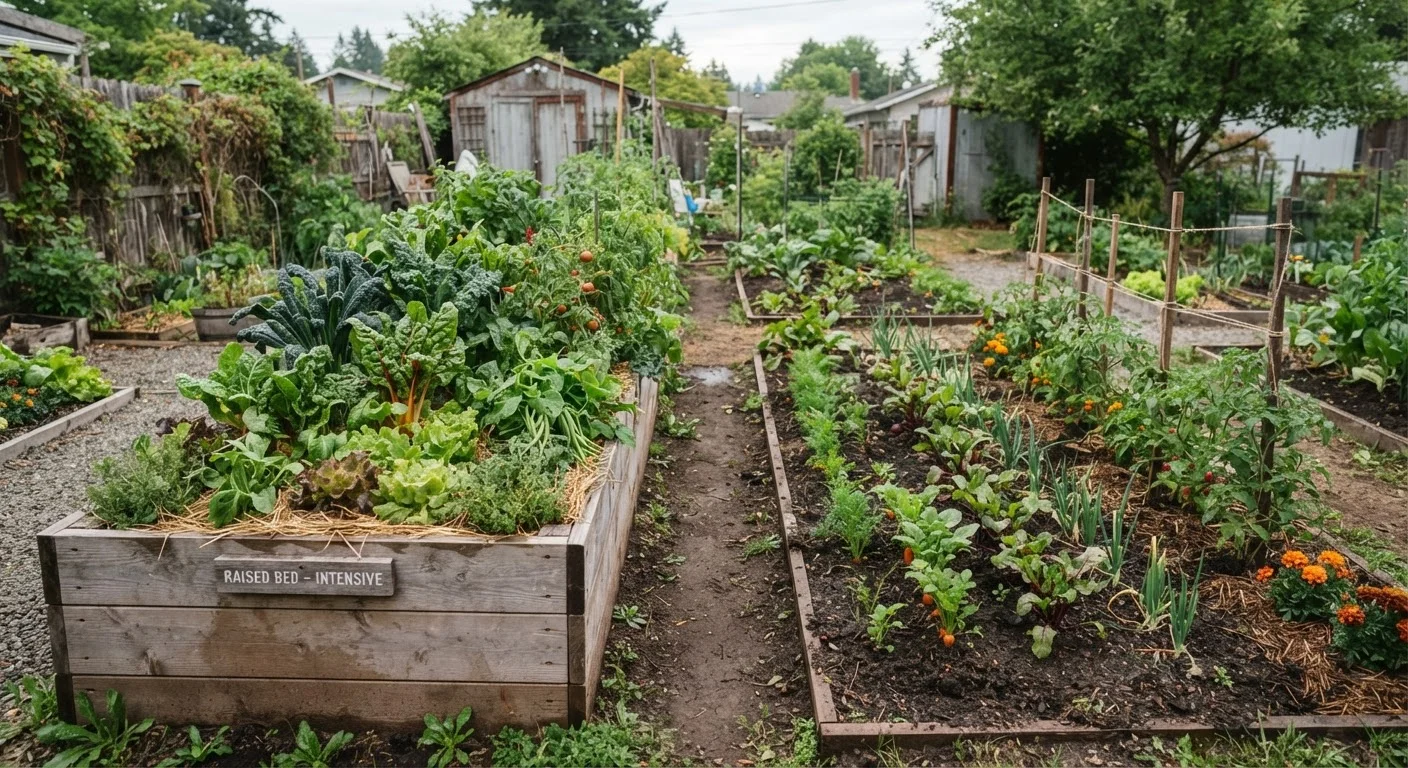
Raised beds
The controlled, higher-upfront approach.
Best for: Families with poor native soil, limited mobility, or small defined spaces who want faster soil-to-harvest results.
Option B
In-ground gardens
The low-cost, larger-scale traditional method.
Best for: Families with decent native soil and room to plant who want the lowest possible startup cost.
If you are starting a garden with almost no money
In-ground gardens
Startup costs are minimal when your soil is workable. Amending native soil with compost is far cheaper than purchasing fill mix for raised beds.
If your yard has compacted clay, rocky, or contaminated soil
Raised beds
Building up rather than digging down bypasses soil problems that would otherwise require expensive remediation or years of amendment work.
If you want to grow a large quantity of vegetables affordably
In-ground gardens
Scaling up an in-ground plot costs little more than seeds and time, while adding raised beds multiplies material and fill-soil expenses.
If physical comfort during gardening matters to you
Raised beds
Beds built 18 to 24 inches tall reduce or eliminate kneeling and bending, which makes sustained gardening more manageable for many adults.
If you want to grow food this season with minimal planning
Raised beds
A filled raised bed is ready to plant immediately. In-ground soil often needs a full season of amendment before it performs well.
What you actually spend to get started
The cost gap between these two approaches is widest at the start. An in-ground garden in reasonably workable soil can be started for under $50: a bag or two of compost, a basic seed packet assortment, and whatever tools you already own. If your soil is compacted or low in organic matter, add another $50 to $100 for amendments, and you are still well below what a single raised bed costs.
A raised bed tells a different story. A standard 4x8-foot cedar frame kit runs roughly $80 to $200. Fill soil is the bigger expense: a quality mix of topsoil, compost, and drainage material to fill that bed to 12 inches can cost $60 to $150 depending on whether you buy bags or bulk delivery. A single bed can easily land at $150 to $350 before you plant a seed. Add a second or third bed and the costs compound fast.
Families who build their own frames from untreated cedar or Douglas fir boards can cut frame costs to $30 to $60 per bed, but fill soil is still the unavoidable line item. For a ground-up approach to starting a food garden on almost no money, in-ground is hard to beat on pure startup math.
| Criterion | Raised beds | In-ground gardens |
|---|---|---|
| Typical startup cost | $150 to $350 per 4x8 bed | $30 to $100 for amendments |
| Ongoing annual cost | $20 to $50 soil topping, frame upkeep | $20 to $60 compost and amendments |
| Soil control | Full control from day one | Dependent on native soil quality |
| Spring soil warmup | 2 to 3 weeks earlier | Standard timing |
| Weed pressure | Lower, especially early on | Higher, requires regular attention |
| Scalability | Costly to expand | Cheap to expand |
| Frame lifespan | 3 to 15 years (material-dependent) | No frame needed |
| Best for contaminated soil | Yes, bypasses native soil | No, soil testing required |
Year-over-year costs and maintenance
The startup cost gap narrows over time. An in-ground garden needs consistent soil care: annual compost additions, occasional pH testing, and cover crops or mulch to protect soil structure between seasons. Those inputs cost money, but amounts are modest, typically $20 to $60 per year for a mid-sized plot.
Raised beds have lower ongoing soil amendment costs per square foot because the contained mix degrades more slowly than exposed native soil. However, wood frames do not last forever. Untreated pine may begin to rot in three to five years in wet climates. Cedar and Douglas fir typically last eight to fifteen years. When a frame fails, replacement boards add a cost in-ground gardening never has.
Weed pressure is lower in raised beds because you fill them with weed-seed-free mix, but not zero. In-ground plots require more regular weeding, especially in the first two seasons before soil is well mulched and planted densely. Factor in time as a real cost if your schedule is tight.
Yield, soil quality, and season length
Raised beds generally produce higher yields per square foot than in-ground gardens in poor-soil yards. Because you control the growing medium completely, root vegetables and shallow-rooted crops perform consistently. The soil also warms two to three weeks earlier in spring, which matters if your growing season is short.
In-ground gardens in good native soil can match or exceed raised-bed yields at a fraction of the cost. Loamy, well-amended soil supports deep-rooted crops like tomatoes, squash, and corn more naturally than most raised-bed mixes, which can dry out quickly in summer heat. Irrigation becomes a bigger concern for raised beds: their improved drainage means they need water more often during dry stretches.
If your yard has contaminated soil (near old paint, a busy road, or a former industrial site), raised beds are the safer choice for growing food. Do not assume native soil is clean without testing it first. Many county extension offices offer low-cost or subsidized soil testing. For ideas on where to put your garden dollars to work broadly, see where landscaping spending pays off and where it does not.