
Flying with Kids vs. Driving: Which Actually Costs Less for American Families

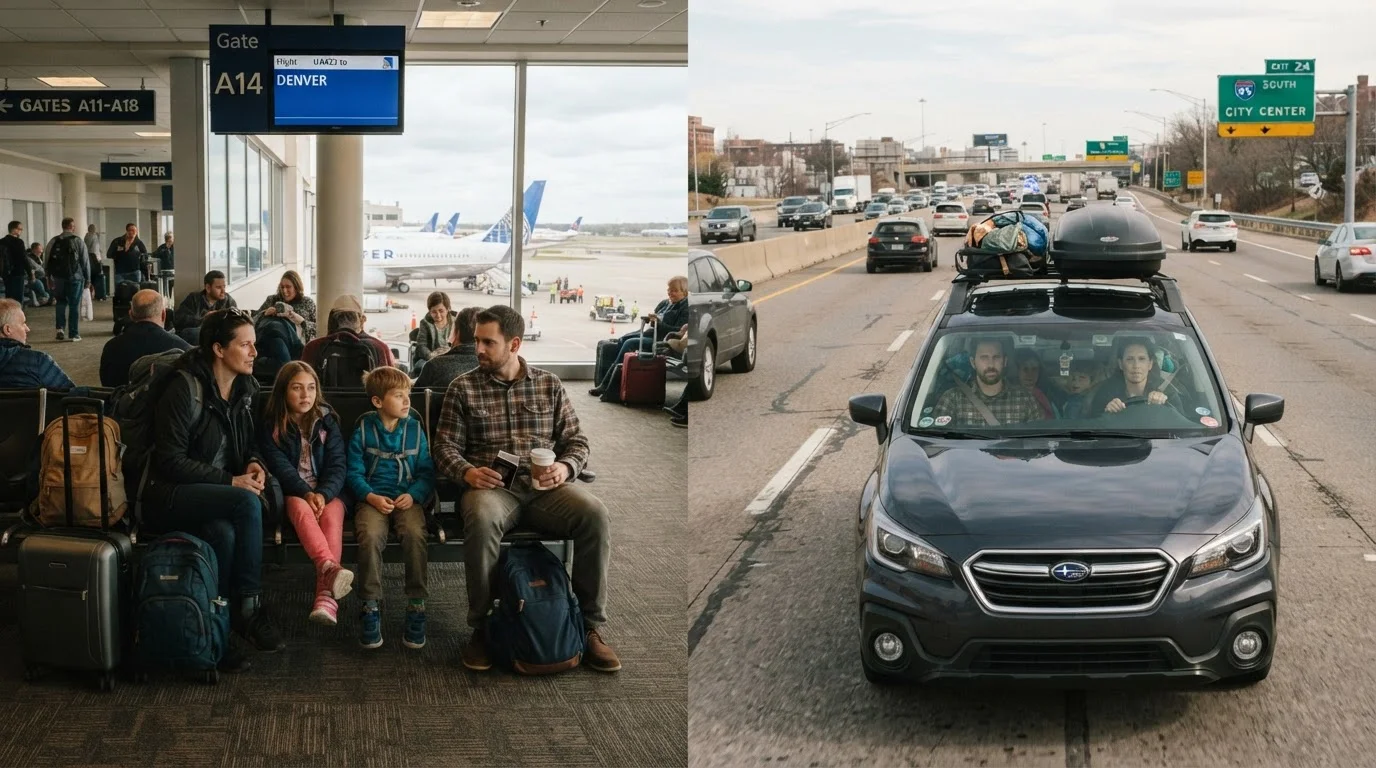
Key Takeaways
Option A
Flying with kids
The faster option with more fee exposure.
Best for: Families traveling long distances where driving time would exceed two days.
Option B
Driving with kids
The flexible option with more controllable costs.
Best for: Families covering 300 to 600 miles who want to manage food and lodging spending directly.
If your destination is more than 900 miles away
Flying with kids
Beyond roughly 900 miles, fuel, lodging en route, and two or more days of road food typically push driving costs above comparable airfares, especially during shoulder season.
If you are traveling with three or more children
Driving with kids
Airline ticket costs scale with every passenger, while a car carries five or more people for the same fuel bill. The per-person advantage of driving grows with each additional child.
If your trip is under 500 miles
Driving with kids
At shorter distances, driving is almost always cheaper when you factor in the full airport cost stack: parking, bags, seats, and ground transport at the destination.
If flexibility and schedule control matter most
Driving with kids
Road trips let families adjust departure times, stop for meals at grocery stores, and skip checked-bag fees entirely, all of which protect the budget from surprise costs.
If time is the binding constraint and distance is long
Flying with kids
When a trip requires more than two days of driving, the additional hotel nights and meals on the road can match or exceed flight costs while consuming vacation days.
How to build a true cost comparison
Most families compare the sticker price of a flight to the cost of gas and stop there. That comparison almost always misleads. A complete cost model for flying includes airfare, checked baggage fees, airport parking or a rideshare to the terminal, seat selection fees, and ground transport at the destination. A complete cost model for driving includes fuel at current prices, tolls, wear on the vehicle (a commonly ignored line item), and any overnight stays if the trip spans more than one day.
For a family of four flying round-trip on a domestic route, checked bags alone can add $200 to $400 to the base fare. Seat selection, when families want to sit together, adds another $60 to $200 depending on the airline and booking timing. A week of airport parking in many US cities runs $100 to $200. Those three items combined can match or exceed the cost of a tank of gas for the entire drive on a mid-range route.
On the driving side, the American Automobile Association estimates the average per-mile operating cost for a mid-size sedan at roughly 17 to 20 cents per mile when factoring in fuel, maintenance allocation, and tire wear. A 500-mile round trip therefore costs approximately $170 to $200 in true vehicle cost, not just gas. Hidden costs that quietly inflate the family vacation budget covers related expenses that catch families off guard at both airports and destinations.
Where each mode wins on price
| Criterion | Flying with kids | Driving with kids |
|---|---|---|
| Base cost (family of 4, 500-mile round trip) | $800 to $1,400+ with fees | $170 to $250 in vehicle costs |
| Scales with number of passengers | Yes, every ticket costs extra | No, same fuel bill regardless |
| Food cost control | Low, airport and in-flight prices apply | High, cooler and grocery stops possible |
| Hidden fees | Bags, seats, parking, ground transport | Tolls, wear, destination parking |
| Time to destination (500 miles) | 3 to 4 hours total with airport time | 7 to 9 hours driving |
| Flexibility | Low, schedule-dependent | High, depart and stop anytime |
| Breakeven distance (approx.) | Favourable above 900 miles | Favourable under 600 miles |
Driving wins on cost for trips under roughly 600 miles when the family has two or more children. The fuel and vehicle cost for that range typically falls between $100 and $250 round-trip, while four round-trip airline tickets with fees rarely come in under $900 on popular routes. The math changes above 900 miles because overnight stays and extra meals add $150 to $300 per overnight stop to the driving total.
Flying becomes competitive when a route requires two or more nights of driving, since those hotel and food costs erode driving's price advantage quickly. Booking flights during shoulder periods, typically the weeks just outside school holidays, can also compress the gap. Shoulder season travel explains when those windows typically fall and how much families can realistically save.
Food is one of the most controllable variables. Families who drive and pack a cooler with prepared food can spend $30 to $50 per day on meals for four. Families flying spend that amount or more at a single airport terminal stop, and in-flight snack purchases add up fast. Family road trips on a tight budget has a structured approach to keeping food costs low across a multi-day drive.
Fees that shift the outcome
Airline ancillary fees have grown substantially over the past decade. Baggage policy varies by carrier and fare class, so families who do not check the fine print before booking often absorb fees they did not budget for. Packing efficiently to avoid checked bags is one of the highest-return moves a flying family can make. Packing light as a family of four walks through what a family actually needs for a week away without checked luggage.
On the driving side, tolls on routes through the Northeast and Midwest can add $20 to $80 to a trip, depending on the corridor. Parking at the destination, particularly in urban areas or resort zones, can run $25 to $50 per day, which erodes the driving cost advantage if the family stays five or more nights. Mapping tolls and destination parking costs before departure gives a more honest picture of total driving expense.
Lodging choices interact with both modes. Families who fly often need a hotel or rental near the airport on travel days. Families who drive can sometimes time their trip to arrive without an overnight, but long routes require factoring in one or two hotel nights. Vacation rental or hotel room breaks down which lodging format tends to cost less for families at the destination.
This article provides general travel cost information for educational purposes. Prices, fees, and fuel costs change frequently. Verify current rates directly with airlines, parking providers, and fuel sources before making travel decisions.